

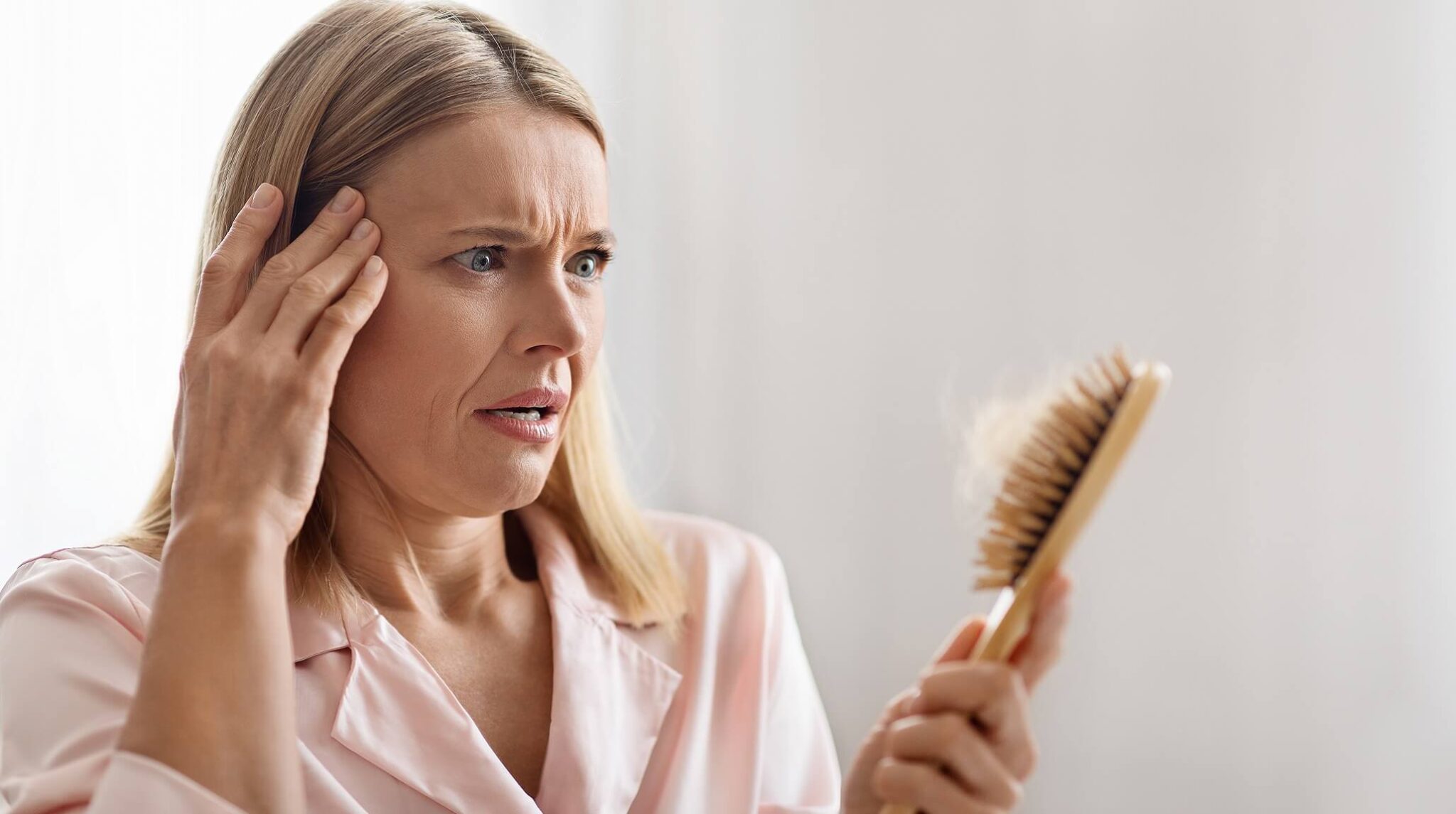
Hair changes during menopause can be surprisingly unsettling. A widening parting may become more noticeable in photographs. The crown can look less dense, the temples may recede, and strands that grow back can feel finer than before. Texture often changes too, leaving hair drier, flatter, frizzier, or more difficult to style.
These are typical changes. More than half of women experience menopausal shedding and thinning, but the problem receives far less attention than symptoms like hot flushes and mood changes. Better understanding of the hormonal effects on the hair growth cycle can help to understand the treatment options available.
Why menopause can affect hair growth
Falling levels of estrogen and progesterone are central to menopausal hair changes. Hair follicles respond to hormones, so declining estrogen can create a relative increase in androgen influence at the follicle. This may contribute to miniaturization, a process in which thicker terminal hairs gradually become finer.
Hormonal changes can also interfere with the growth cycle. Reduced estrogen means a shorter growth phase and a higher proportion of hairs entering the resting or shedding phase. This may explain two complaints that are often heard together: more hair is being lost, and the replacement hair appears thinner.
The resulting pattern can resemble female pattern hair loss. Common signs include a broader central parting, reduced density at the crown, and recession around the temples. Scalp specialist Kelly Morrell, founder of Scalp Confidential, also sees changes in volume, shine, and manageability among midlife clients.
The effects aren’t purely cosmetic. Hair can be closely connected to identity, femininity, and a sense of vitality. When its density or texture changes, the emotional impact may be disproportionate to the amount of hair lost.
Is hormone replacement therapy enough?
Falling estrogen is a factor in thinning during menopause, so hormone replacement therapy might seem the obvious answer. It may help some women, but it shouldn’t be considered a reliable restorative hair treatment in itself.
Stabilizing hormones may improve the scalp environment. However, existing miniaturization or pattern hair loss may still require treatment directed at the follicles. Morrell notes that clients sometimes expect their hair to recover completely after beginning HRT, only to find that direct scalp and follicle support remains necessary.
This distinction matters. Hormone care may address one contributor to hair loss without resolving every process affecting growth. The most suitable approach will depend on what is driving the thinning in each person.
Look beyond hormones
Midlife hair loss is rarely explained by hormones alone. Stress and poor sleep may encourage more follicles to enter a shedding phase. Insufficient protein or calories can also affect growth because the body deprioritizes hair during periods of stress or nutritional deficit.
Several other issues can mimic or exacerbate menopausal shedding. ‘Iron stores and ferritin, vitamin D, vitamin B12, folate, zinc, and thyroid dysfunction are all relevant considerations,’ says Dr. Bawa. That’s why an assessment might involve bloodwork, hormone monitoring, or a closer look at the scalp, rather than just blaming every change on menopause.
A layered strategy may therefore be more appropriate than relying on one intervention. Hormonal and nutritional factors can be addressed where relevant, while topical treatment provides support directly to the follicle. Neither side of that approach should be treated as a substitute for the other.
A diagnostic scalp assessment is particularly useful when the pattern or cause of hair loss is unclear. Scarring alopecia must be ruled out before certain topical systems are considered, and treatment is more likely to be suitable when follicles are still present.
Where targeted topical support may fit
One option used both at home and in specialist clinics is the CALECIM® Professional Hair Serum. The system combines a topical serum containing PTT-6® exosomal proteins with a medical-grade dermastamper. Controlled micro-stamping creates temporary channels in the scalp to enhance delivery of the serum, which may help improve the appearance of thinning hair.
PTT-6® is described by Dr. Bawa as a blend of signaling proteins derived from umbilical cord lining stem cells. The system can be administered in a clinic when professional oversight is preferred, but it is also designed for guided use at home.
Dr. Bawa evaluated the serum in 12 perimenopausal women in 2025 using the Dermastamper. Changes typically began to become noticeable between six and 12 weeks. At week six, nine of the 10 participants who completed the assessment reported improvements, including greater apparent thickness and volume around the temples and hairline. By week 12, every participant who completed the study reported that their hair looked thicker.
Reported side effects were generally mild and usually associated with micro-stamping, including temporary redness, tenderness, or brief scalp sensitivity. The serum itself was described as well tolerated, including by people with sensitive skin.
Treat the cause as well as the visible change
Menopausal hair loss is best approached as a problem with several possible contributors. Hormonal changes can alter the growth cycle and encourage miniaturization, but nutrition, stress, sleep, thyroid function, and underlying hair-loss conditions may also shape what happens at the scalp.
HRT may form part of the answer for some women, although it shouldn’t be expected to reverse thinning by itself. Investigating internal factors and adding appropriate follicle support offers a more considered path.
Above all, early changes shouldn’t be dismissed as an unavoidable part of aging. Identifying the pattern, checking for contributing factors and choosing treatment while follicles are still present may provide a clearer route through one of menopause’s least discussed symptoms.
