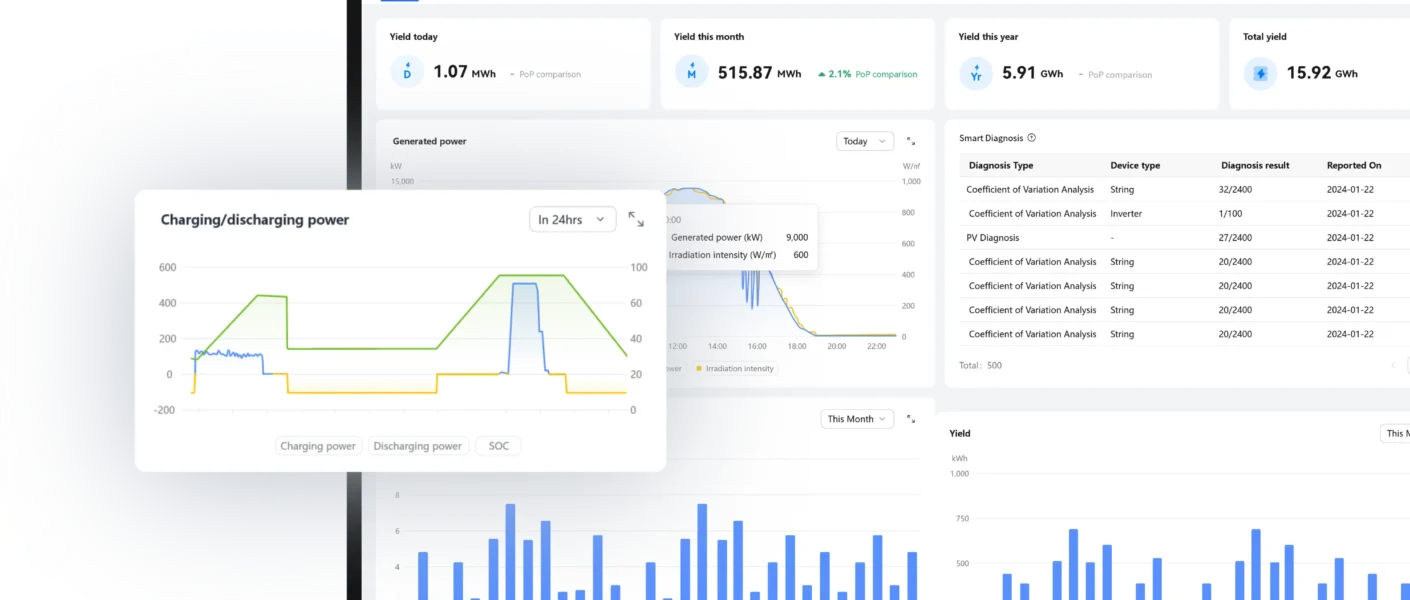
For a site applying a grid-export limit, equipment decisions must follow the required service and the conditions of the actual site. SmartLogger is a communication and control gateway used in photovoltaic plants to connect field devices with monitoring and supervisory systems. The Huawei SmartLogger3000A documentation describes RS485, Ethernet and selected wireless options, along with plant-level active power management functions. In this context, SmartLogger brings together specific components and controls rather than a single isolated device.
Export limitation requires timely measurements at the grid connection and a verified command path to controllable inverters. Equipment ratings, control policies and the responsibilities of the operating team should therefore be aligned before commissioning. A design assumption should be documented when it cannot yet be confirmed by measurements.
Communications gateway design
SmartLogger aggregates information from compatible PV inverters, power meters and environmental devices. Its role is distinct from that of a module optimizer or a cloud dashboard: it handles field communication and selected local control tasks.
Field wiring should respect cable length, shielding, terminations and electromagnetic interference. Stable data capture depends on both physical communications quality and correct software settings for every connected device.
Protocols and data integration
The product documentation lists protocols including Modbus RTU, Modbus TCP and IEC 60870 variants for specified interfaces. Third-party integration should use the supported register map and test the complete set of required data points.
Data transmission security, account permissions and network segmentation should form part of deployment. A control gateway with remote accessibility deserves stricter change procedures than a passive display terminal.
Plant-level control functions
A zero-export or export-limit scheme uses a meter at the appropriate point of connection and commands inverter output accordingly. Incorrect meter direction or communications delay can make the controller act on the wrong power balance.
Grid requirements may include active power limits, reactive power management and protective coordination. The specific functional scope must be validated for the logger model, inverter firmware and local grid code.
Commissioning and operation
Installation should include verification of power supply, earthing, device addresses, RS485 polarity and network routes. Commissioning records should list which equipment is connected to each interface and the expected data refresh interval.
The site operator can use logger communications alarms to identify missing devices or a failed link. A prolonged outage should be distinguishable from zero power production; otherwise performance reports will be misleading.
The most useful operational indicators relate to completed service, monitored equipment health and compliance with site limits. Collecting these values over normal and peak periods helps reveal whether a control policy remains appropriate.
These considerations show why SmartLogger should be specified by its architecture, operating limits and interfaces. SmartLogger brings field measurements and plant commands into a manageable interface. Its technical value depends on correctly configured device connections, reliable metering and tested control pathways. The final selection still depends on applicable standards, actual site conditions and model-specific documentation.